



Preventive Maintenance for Paper Bag Machines: A Schedule That Actually Prevents Downtime
A preventive maintenance schedule is only as good as the failure it stops before it happens. Most paper bag machine downtime does not come from a catastrophic breakdown. It comes from a slow drift, tension creeping out of calibration, a glue nozzle partially clogging, a sensor reading a few degrees off, until one shift the line stops and nobody can say exactly when the problem started. A schedule built around that pattern looks different from a generic maintenance calendar copied from a manual.
This is not a call to do more maintenance. It is a case for doing the right maintenance at the right interval, on the systems that actually cause downtime, and for measuring the two numbers that tell you whether the plan is working. It follows directly from the capacity questions we set out in our 2027 outlook: a line running above 85% of achievable capacity has no slack for unplanned stops, which makes the maintenance plan the thing standing between a full order book and a missed delivery.
Maintenance is a capacity decision, not just a technical one
The short answer: every hour of unplanned downtime is capacity you have already sold and cannot deliver. Preventive maintenance is not a cost centre competing with production, it is what protects the utilisation number your capacity plan is built on.
ISO/TC 251, the international technical committee for asset management, frames this precisely: maintenance is not a standalone function to be minimised, it is one lever in maximising the value an asset returns over its whole working life. For a converter, that reframes the maintenance budget conversation. The question is not how little can we spend on maintenance, it is what level of unplanned downtime is the business actually willing to absorb, and what does preventing it cost against that number.
The same logic that applies to Overall Equipment Effectiveness applies here: a machine’s real output is nameplate speed minus every stop, planned and unplanned, and unplanned stops are the ones a maintenance schedule exists to remove. A converter running near capacity cannot absorb the same unplanned downtime as one running at 60%, because there is no slack shift to make up the lost output.
A preventive maintenance schedule in four layers, not one calendar
The short answer: effective preventive maintenance splits into four layers by frequency, not one generic monthly checklist. Each layer catches a different class of failure, and skipping a layer does not save time, it moves the cost to an unplanned stop later.
EN 13306, the European standard for maintenance terminology, separates preventive maintenance, carried out at predetermined intervals or to prescribed criteria to reduce the probability of failure, from corrective maintenance carried out after a fault. The four layers below are the preventive side of that split, ordered by how often each check runs.
| Layer | Who performs it | What it catches |
|---|---|---|
| Per shift | Operator, at changeover or start of shift | Visual and audible drift: unusual noise, glue bead consistency, seal appearance, obvious wear |
| Weekly | Operator or line technician | Tension calibration checks, lubrication points, sensor cleaning, blade sharpness spot-checks |
| Monthly | Maintenance technician | Belt and chain wear, electrical connections, glue system deep clean, alignment verification |
| Annual or by running hours | Technician, often with OEM support | Bearing replacement on schedule rather than on failure, full drive system inspection, control system calibration |
The per-shift layer is the one most often skipped under schedule pressure, and it is the one that catches problems while they are still cheap to fix. An operator who checks glue bead consistency at every changeover catches a partially clogged nozzle before it produces an hour of defective bags, not after.
The five systems that cause most unplanned downtime
The short answer: a small number of systems account for most stops on a bag making or bagging line. Weighting your preventive maintenance toward these five gets you more downtime prevention per hour of maintenance time than spreading effort evenly across the whole machine.
| System | Typical failure pattern | What scheduled inspection catches |
|---|---|---|
| Tension control | Gradual drift with humidity, roll changes, component wear | Out-of-spec tension before it produces wrinkled or misaligned bags |
| Glue application | Nozzle clogging, viscosity drift, pump wear | Weak or inconsistent seals before a batch fails downstream |
| Sensors and controls | Slow calibration drift, contamination on optical sensors | Registration and temperature errors before output quality degrades for a full shift |
| Cutting and creasing blades | Gradual dulling, not sudden failure | A rough cut or weak crease before it fails quality control |
| Drive and transmission | Bearing and belt wear, often failing suddenly once worn | Full stops, by replacing on a running-hours schedule instead of waiting for failure |
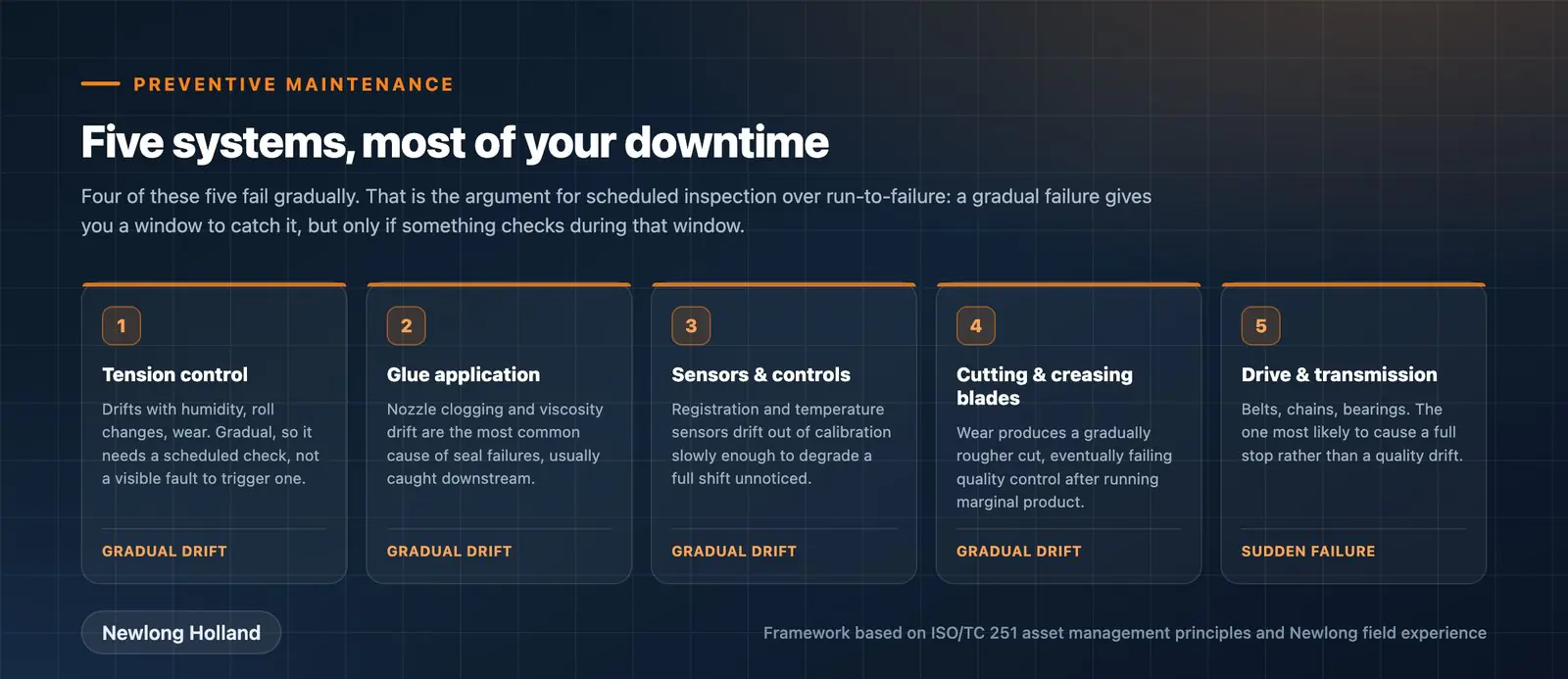
- Tension control. Paper tension drifts with humidity, roll changes and wear on tensioning components. Drift is gradual, which is exactly why it needs a scheduled check rather than waiting for a visible fault.
- Glue application. Nozzle clogging, viscosity drift and pump wear are the most common causes of seal failures, and seal failures are usually caught downstream, after material has already been consumed.
- Sensors and controls. Registration sensors, temperature sensors on sealing stations, and counting sensors drift out of calibration slowly enough that output can degrade for a full shift before anyone notices.
- Cutting and creasing blades. Blade wear does not fail suddenly, it produces a gradually rougher cut or crease that eventually fails quality control, at which point you have been running marginal product for longer than anyone realised.
- Drive and transmission. Belts, chains and bearings are the components most likely to cause a full stop rather than a quality drift, which is why they belong on a running-hours replacement schedule rather than a run-to-failure approach.
Four of these five fail gradually. That is the practical argument for scheduled inspection over reactive repair: a gradual failure gives you a window to catch it before it becomes a stop, but only if something is actually checking during that window.
The two numbers that tell you if the plan is working
The short answer: track mean time between failures and mean time to repair. Together they tell you whether your preventive maintenance is actually preventing failures, and whether your team can recover quickly when one happens anyway.
Mean time between failures, MTBF, is the average running time between unplanned stops. If it is rising over successive quarters, your preventive maintenance is working. If it is flat or falling despite a maintenance schedule being followed, either the schedule is targeting the wrong systems or intervals need tightening. Mean time to repair, MTTR, is how long an unplanned stop actually takes to resolve. A high MTTR usually points to a spare parts or documentation problem rather than a maintenance problem: the fix is known, but the part or the procedure was not ready when needed.
Both numbers matter for a reason beyond your own operation. When you specify a new machine, a supplier’s historical MTBF and MTTR data on comparable equipment is a far more useful question to ask than a general reliability claim, and your own numbers are the baseline you are trying to improve on with the next purchase.
What to keep on the shelf, and what to order on demand
The short answer: stock the parts whose failure stops the whole line and whose lead time exceeds the downtime you can absorb. Order everything else against a known replacement schedule instead of tying up capital in inventory you may never use.
- Stock on site: the specific belts, seals, glue nozzles and sensors your machine uses, wear items with short service life relative to your production calendar, and anything with a supplier lead time longer than your acceptable downtime.
- Order against a schedule: bearings and drive components due for running-hours replacement, where you know the date months in advance and can order to arrive just before it.
- Order on demand: major structural components with very low failure rates, where holding stock ties up capital against a risk that a running-hours inspection programme should catch well before failure.
The mistake we see most often is the inverse of this: capital tied up in slow-moving structural spares while the fast-wearing consumables that actually cause most stops, glue nozzles, sensors, seals, run short because nobody tracked usage against the maintenance calendar.
When maintenance turns into a replacement decision
The short answer: if MTBF has been falling for several consecutive quarters despite a properly followed maintenance schedule, and the repair cost per incident is climbing, you are past the point where more maintenance fixes the underlying problem.
A machine that needs increasing maintenance hours to hold the same output is telling you something a maintenance schedule alone cannot fix: the underlying components are wearing out faster than they can be restored. At that point the question shifts from how to maintain this line to whether the capital case for a second or replacement line, the one we set out in our guide on when and how to add a second machine, has moved from a growth decision to a reliability one. The financial case is the same either way: compare the fully loaded cost of continuing to maintain against the cost of new capacity.
Frequently asked questions
What is preventive maintenance for a paper bag machine?
It is scheduled inspection and servicing carried out before a component fails, rather than repair after a breakdown. It typically spans four frequency layers: per-shift operator checks, weekly technician checks, monthly deeper servicing, and annual or running-hours-based major inspection.
How often should a paper bag machine be serviced?
There is no single interval that applies to every machine. The right frequency depends on the specific equipment, the paper grades run, and duty cycle, and should follow the manufacturer’s documentation and your own running-hours log. What generalises is the structure: per-shift, weekly, monthly and annual layers, each catching a different class of failure.
What causes the most unplanned downtime on a bag making line?
In most operations, five systems account for the majority of stops: tension control, glue application, sensors and controls, cutting and creasing blades, and the drive and transmission system. Four of these five fail gradually, which is why scheduled inspection catches them before they become a full stop.
What is MTBF and why does it matter?
Mean time between failures is the average running time between unplanned stops. Tracking it over successive quarters tells you whether your preventive maintenance programme is actually reducing failures. A rising MTBF means the programme is working; a flat or falling one means intervals or targeted systems need adjustment.
What is MTTR and why does it matter?
Mean time to repair is how long an unplanned stop takes to resolve once it happens. A high MTTR usually points to a spare parts availability problem or a documentation gap rather than a maintenance scheduling problem, since the fix itself is typically already known.
Which spare parts should be stocked on site?
Fast-wearing consumables specific to your machine, such as glue nozzles, seals and sensors, and any part whose supplier lead time exceeds the downtime your operation can absorb. Slow-wearing structural components are usually better ordered against a known running-hours replacement schedule than held as standing inventory.
Can operators perform preventive maintenance, or does it require a technician?
Both have a role. Per-shift checks, visual and audible drift detection, are usually performed by operators as part of changeover routine. Weekly and monthly layers typically require a trained line technician, and annual major inspection often benefits from OEM support, particularly for warranty-relevant work.
How does preventive maintenance relate to Overall Equipment Effectiveness?
OEE measures real output against nameplate speed after every stop, planned and unplanned, is accounted for. Preventive maintenance is the main lever for reducing unplanned stops specifically, which is usually the largest and most controllable loss category in an OEE breakdown.
Is preventive maintenance worth the cost if the line is not running near capacity?
Yes, though the urgency differs. A line with spare capacity can absorb an unplanned stop by running an extra shift or extending a run. A line near capacity cannot, because there is no slack to recover the lost output. The maintenance discipline should exist regardless; the cost of skipping it is simply higher on a fully loaded line.
When does a maintenance problem become a replacement decision?
When mean time between failures has been falling for several consecutive quarters despite a properly followed maintenance schedule, and the cost per repair incident is climbing. That pattern indicates the underlying components are wearing out faster than maintenance can restore them, which shifts the question from servicing to replacement economics.
Does the PPWR shift towards mono-material paper change maintenance requirements?
It can. Coated mono-material stock behaves differently under tension and heat than uncoated kraft, which means tension control and sealing-station temperature checks deserve closer attention when a line switches construction. We covered the paper-behaviour side of this in our guide to mono-material paper packaging and PPWR recyclability grades.
Who should set the maintenance schedule for a new machine?
Start from the manufacturer’s documentation, then adjust intervals based on your own running-hours log and MTBF trend once you have operating history. A schedule copied from a different machine or a different paper grade is a starting point, not a finished plan.
Building the schedule around your own failure data
A maintenance schedule copied from a manual is a starting point. A maintenance schedule built from your own MTBF and MTTR trend, weighted toward the five systems that actually cause your stops, is the one that protects the capacity you have already sold.
Newlong has built bag making, bag sewing and bagging equipment since 1941. From Schiphol-Rijk, Newlong Holland supplies European converters with machines, spare parts and service. The questions in this guide are the ones our maintenance and support team works through with converters: which parts belong on the shelf, which intervals to tighten, and which checks need a technician rather than an operator.
If you are commissioning a new line or want a second opinion on where your current maintenance effort is going, our team can review your failure history against the systems it should be weighted toward. Get in touch and we will start from your own downtime data.