



Scaling Paper Bag Production: When and How to Add a Second Machine
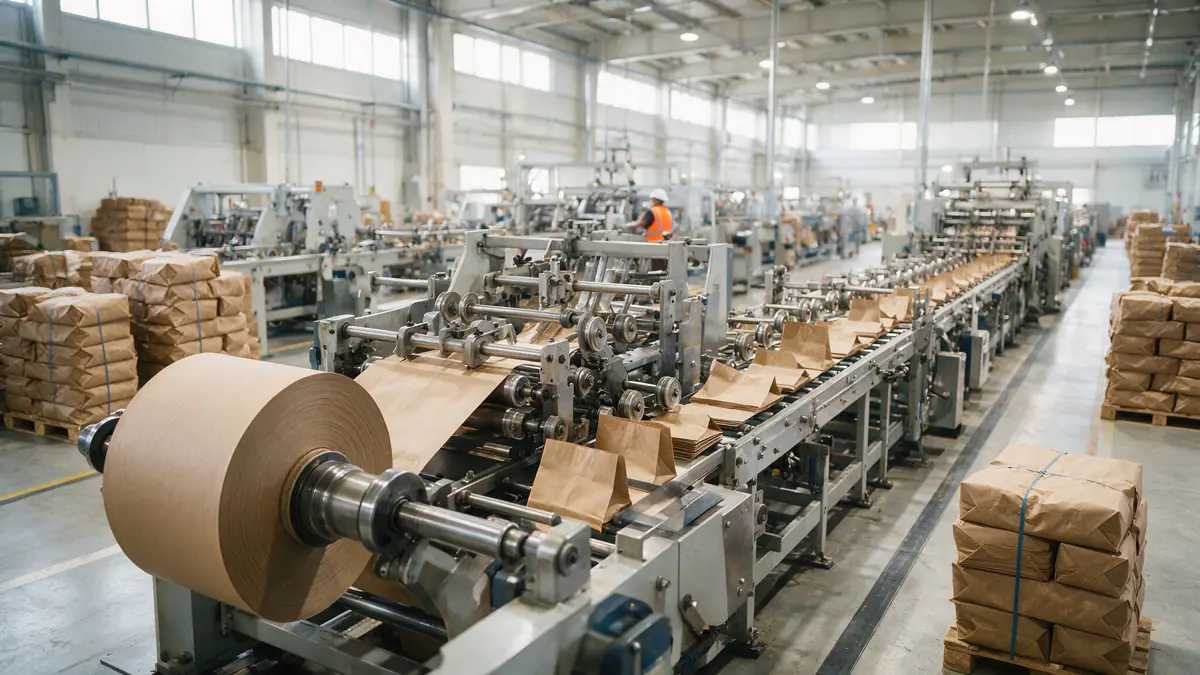
At some point, every growing converter asks the same question: do we push the line we have harder, or do we invest in a second paper bag machine? Get the timing wrong in either direction and it costs real money. Wait too long and you turn away orders, run unsustainable overtime, and lose customers to competitors who can deliver on time. Move too early and you carry idle capacity, tie up capital, and stretch a workforce that was already thin.
This guide lays out how to tell the difference. It draws on what we see across converters who have made this call well, and on the commissioning conversations we have with customers scaling from one paper bag making line to two or more. If you are watching your order book grow and wondering whether it is time to add a second paper bag machine, the framework below will help you decide with numbers instead of instinct.
The real capacity of a single line, not the nameplate number
Every machine has a nameplate speed. Almost no plant runs at it. Between changeovers, material variation, planned maintenance, and the ordinary friction of a working shift, sustained output typically lands at 65 to 80% of nameplate over a full month. A line rated at 300 bags per minute is, in practice, a 200 to 240 bag-per-minute line once you average across a real production calendar. This gap between rated and achievable output is the same distinction manufacturers track through Overall Equipment Effectiveness (OEE), and it is the number that should drive a second paper bag machine decision, not the spec sheet.
Before deciding whether you need a second machine, calculate your actual achievable capacity, not the number on the spec sheet. Track four things over a rolling 90-day window: average output per shift, scheduled uptime versus actual uptime, changeover frequency and duration, and scrap rate. Multiply achievable output by your available shift hours per month. That number, not the nameplate figure, is what you compare against demand. For context on how your plant’s utilisation compares to the wider packaging machinery sector, PMMI, the Packaging Machinery Manufacturers Institute, publishes regular industry capacity and investment benchmarks.
Five signals it is time to add a second machine
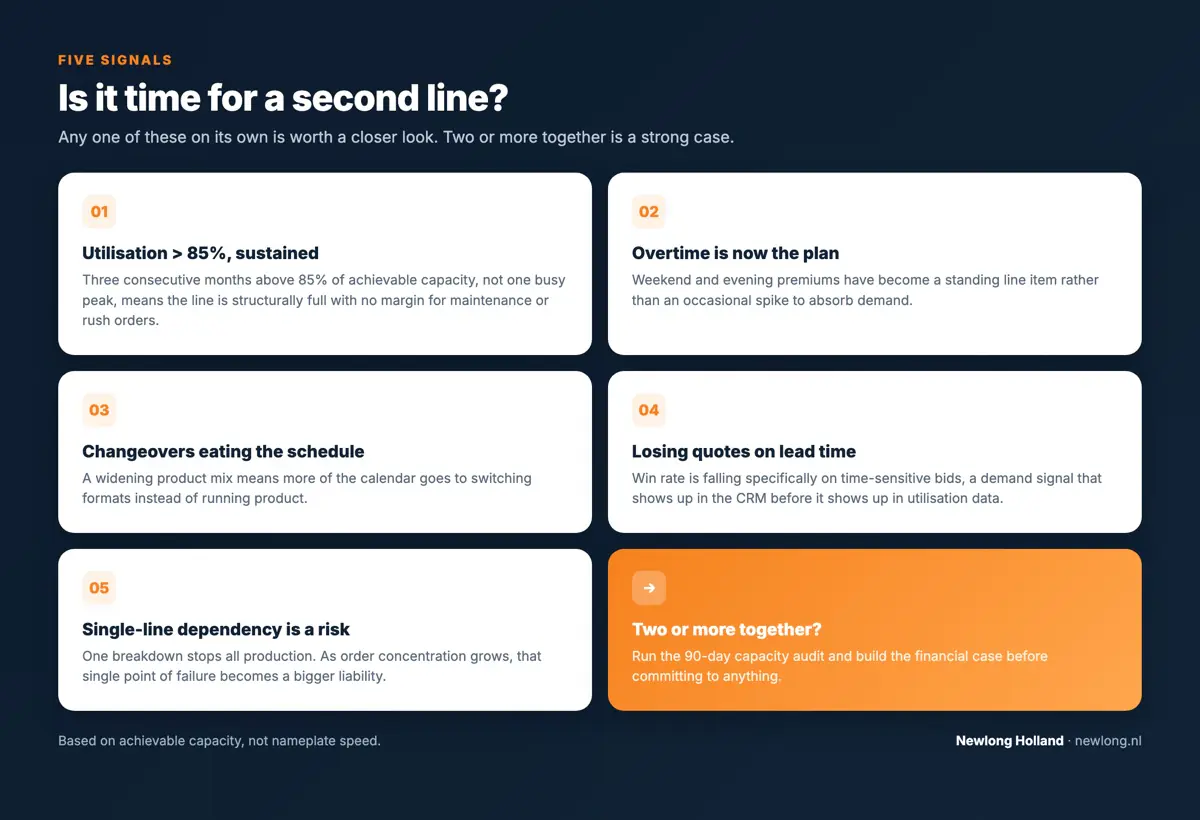
1. Sustained utilisation above 85%
A single line running above 85% of its achievable capacity for three consecutive months, not one busy peak, is structurally full. Above that threshold there is no slack for planned maintenance, no room to absorb a rush order, and every unplanned stop turns into a missed delivery. Utilisation in the 70 to 85% range is healthy and sustainable. Above 85% for a sustained period is a plant running without a safety margin.
2. Overtime has become the plan, not the exception
Occasional overtime absorbs a spike. Overtime that shows up on the schedule every week is a second shift’s worth of demand being run through unsustainable labour costs instead of unsustainable capital costs. Once weekend and evening premiums become a standing line item, the economics usually favour a second machine over permanent overtime, especially once you account for operator fatigue, higher error rates on tired shifts, and retention risk.
3. Changeover time is eating a growing share of the schedule
As product mix diversifies, a single line spends more of its calendar switching formats rather than running. If changeovers have grown from an occasional interruption to a daily event, a second line lets you dedicate one machine to your highest-volume, most stable formats and use the other for shorter runs and new product trials. Splitting the mix this way often recovers more effective capacity than the raw throughput numbers suggest, a pattern we see across the seven industries covered in our bagging engineering guide.
4. You are quoting longer lead times to win business
When your sales team starts quoting two or three weeks longer than they did a year ago, and losing quotes on lead time rather than price, that is a demand signal showing up in your CRM before it shows up in your utilisation figures. Track win rate against quoted lead time. A falling win rate on time-sensitive bids is often the earliest reliable indicator that capacity, not price, is the constraint.
5. Single-line dependency has become a real business risk
With one line, a major breakdown does not just cost you a repair bill, it stops all production. As order volume and customer concentration grow, that single point of failure becomes a bigger liability. A second paper bag machine is not only a capacity investment, it is redundancy that protects the relationships you have already built. For customers running contracts with penalty clauses for late delivery, this alone can justify the investment before the capacity math even applies. Good preventive maintenance on both lines matters even more once you are running redundant capacity, see our maintenance guide for the routines that keep unplanned downtime rare on either line.
The financial case: what a second line actually costs and returns
The purchase price of the machine is the visible number. It is rarely the deciding one. Build the comparison around total cost of the added capacity against the revenue and margin it unlocks.
- Capital cost. Machine price, installation, facility modifications, and any additional material handling or palletising equipment needed to feed a second line.
- Incremental operating cost. A second crew, additional maintenance spend, higher utility draw, and the training investment covered in our operator training guide.
- Cost of the alternative. What you are already paying in overtime premiums, expedited freight to cover missed dates, and lost orders you are currently turning away or losing on lead time.
- Revenue and margin unlocked. Not just the orders you can now accept, but the pricing power that comes from quoting competitive lead times again.
Run this as a real payback calculation, not a gut check. Many converters find that once overtime, expedite costs, and lost-order value are added up honestly, the second line pays back faster than the sticker price suggests, often inside 18 to 30 months depending on utilisation ramp.
Same specification, or a complementary second line?
Once the decision is made, the next question is what to buy. There are two common paths, and the right one depends on what drove the decision in the first place.
Duplicate the line you already run
If the constraint is pure volume on a stable product mix, a second identical line is usually the simplest choice. Your operators already know the machine, your spare parts inventory covers both lines, and your maintenance team does not need to learn a second platform. This is the lowest-risk path and the fastest to commission, because the training and troubleshooting playbook you already have applies directly. The same logic applies to closing equipment, our bag sewing buyer’s guide covers how to size a second closing station once the making line is running double shifts.
Add a complementary configuration
If the real constraint is changeover time or a widening product mix, a second line configured differently, a roll-fed line alongside a sheet-fed one, or a different closing method from our bag-sewing or bag-engineering ranges, can solve the mix problem rather than just doubling the volume problem. This path takes more planning and a second training track, but it often recovers more effective capacity than a straight duplicate, because it stops forcing every format through the same changeover cycle.
Facility and workforce planning: the parts people forget to budget
The machine itself is rarely the bottleneck in a scaling project. These four items are the ones that most often slip the schedule:
- Floor space and material flow. A second line needs its own paper roll staging, WIP storage, and a palletising path that does not cross the first line’s traffic. Map the physical layout before committing to a footprint, not after.
- Power and utilities. Confirm electrical capacity, compressed air, and any process utilities can support two lines running simultaneously, not just on paper but under real peak-load conditions.
- Workforce ramp. Plan for three to five trained operators per line per shift pattern, following the workforce guidance in our operator training guide. Recruiting and training a second crew takes longer than installing the machine, so start it in parallel, not after commissioning. Skilled-labour availability is a recurring theme across manufacturing, The Manufacturing Institute tracks the workforce trends behind it in more depth than we can cover here.
- Supervisory capacity. Doubling machine count without adding supervisory bandwidth is a common failure mode. Someone needs to own quality, scheduling, and troubleshooting across two lines from day one.
A phased approach to commissioning line two
Bringing a second line online while the first keeps running is a different exercise from a greenfield installation. The sequence that works best for most converters:
- Phase 1, pre-order. Finalise the capacity case, confirm facility readiness, and start recruiting the second crew before the machine ships. Lead times on new equipment typically run 12 to 20 weeks, use that window productively.
- Phase 2, installation and commissioning. Schedule installation to minimise disruption to line one, and run commissioning and safety sign-off on the new line’s own timeline rather than compressing it to hit an arbitrary go-live date.
- Phase 3, parallel ramp. Run both lines below full utilisation for the first 4 to 8 weeks while the second crew works through the training phases in our operator training framework. Resist the temptation to load line two to capacity immediately.
- Phase 4, full integration. Once line two is running at target speed and scrap rate, rebalance the product mix across both lines based on what you learned about changeover patterns during the ramp.
How Newlong supports scaling customers
We commission a meaningful share of our new installations for customers adding capacity to an existing plant, not starting from zero. That changes what support looks like. Our engineering team reviews your current line’s product mix and changeover data before recommending whether a duplicate or a complementary configuration fits your growth pattern. Commissioning is scheduled around your live production, not the other way round, and the operator training for your second crew follows the same structured framework we use for a first installation, delivered by the technicians who know your specific paper grades and product range.
If you are watching utilisation climb and wondering whether the numbers justify a second line, talk to our team. We can help you build the capacity case against your actual production data before you commit to anything.
Frequently asked questions
1. What utilisation rate means we should add a second machine?
Sustained utilisation above 85% of achievable capacity for three consecutive months, not a single busy period, is the clearest signal. Below that, most plants still have enough margin to absorb demand growth without adding a line.
2. Should the second paper bag machine be identical to the first?
If the constraint is pure volume on a stable product mix, yes, a duplicate is the lowest-risk, fastest-to-commission path. If the constraint is changeover time or a widening product range, a complementary configuration, such as pairing a roll-fed line with a sheet-fed one, often recovers more effective capacity.
3. How long does it take to go from decision to a running second line?
Equipment lead times typically run 12 to 20 weeks, plus installation and a 4 to 8 week parallel ramp period before the line reaches target speed and scrap rate. Budget 6 to 9 months from purchase order to full integration.
4. How many operators do we need for a second line?
Plan for three to five fully trained operators per line depending on shift pattern, the same guidance we set out in our operator training framework. Start recruiting and training well before the machine arrives, since building a competent crew takes longer than installing the equipment.
5. Is overtime cheaper than a second machine?
In the short term, yes. Once overtime becomes a standing weekly line item rather than an occasional spike, the economics usually flip. Add up weekend and evening premiums, fatigue-related scrap and error rates, and retention risk before comparing it against the capital cost of a second line.
6. What facility changes should we plan for besides the machine itself?
Floor space and material flow, electrical and compressed-air capacity under real peak load, and supervisory bandwidth across two lines are the items most likely to slip a schedule. Map these before committing to a footprint or an installation date.
7. How do we know if it is lead time or price costing us orders?
Track your win rate against quoted lead time separately from win rate against price. A falling win rate specifically on time-sensitive bids, while price-competitive bids still convert normally, points to capacity as the constraint rather than pricing.
8. Can we run the second line’s commissioning without disrupting the first?
Yes, with planning. Schedule installation and commissioning around your existing production calendar, keep the second line below full utilisation during the first 4 to 8 week ramp, and avoid compressing safety sign-off to hit an arbitrary go-live date.
9. What is the typical payback period for a second line?
It varies by utilisation ramp and product margin, but many converters see payback inside 18 to 30 months once overtime savings, expedite-cost avoidance, and previously lost orders are included in the calculation alongside new revenue.
10. Does single-line dependency matter even if we are not at full capacity yet?
Yes, for customers with contracts carrying late-delivery penalties or highly concentrated order books, redundancy against a major breakdown can justify a second line before the raw capacity math does. It is a risk decision as much as a volume decision.
11. Should we upgrade our current line before adding a second one?
If your existing line is running well below its achievable capacity due to a fixable issue, such as poor changeover discipline or an outdated control system, closing that gap can be faster and cheaper than adding capacity. Run the 90-day capacity audit first to be sure the constraint is real, not a process fix in disguise.
Ready to build your capacity case?
Whether you are close to the decision or still gathering the numbers, we can help you build the case for a second paper bag machine grounded in your actual production data rather than guesswork. Get in touch with our team to talk through your utilisation, product mix, and growth plans.