



Mono-Material Paper Packaging: What PPWR Recyclability Grades Require of Your Line
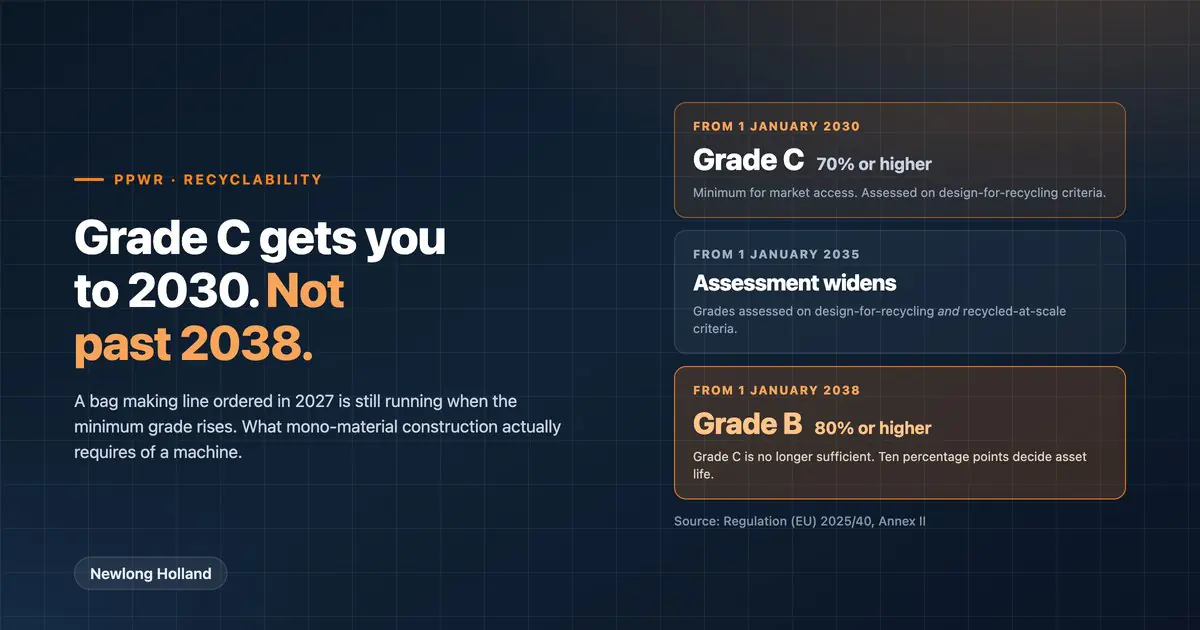
Under the EU Packaging and Packaging Waste Regulation, recyclability is not a yes or no answer. It is a grade. Regulation (EU) 2025/40 sets three: Grade A at 95% or higher by weight, Grade B at 80% or higher, and Grade C at 70% or higher. Anything below Grade C cannot be placed on the EU market at all. From 1 January 2030, Grade C is the minimum. From 1 January 2038, the minimum rises to Grade B.
That second date is the one almost nobody plans for, and it is the reason this matters now. A bag making line ordered in 2027 is commissioned in 2028 and, on any normal depreciation schedule, is still running in 2038. Specify it to just clear Grade C and it will comply for its first decade and fall off the market in its second. This article sets out what actually costs a paper bag its percentage points, what mono-material construction requires of a line, and what to put in a machine specification now.
What the grades actually measure
The short answer: the grade is the share of the packaging unit, by weight, that can be recycled. The threshold you must clear changes twice, and the basis on which it is assessed changes once.
Two things move between now and 2038. The threshold rises from 70% to 80%. And in 2035 the assessment basis widens: until then grades are established on design-for-recycling criteria alone, from 2035 they are established on design-for-recycling and recycled-at-scale criteria. A pack can be beautifully designed for recycling and still fail the second test if the infrastructure to recycle it at volume does not exist in practice.
| Grade | Recyclable share by weight | Market access |
|---|---|---|
| A | 95% or higher | Permitted throughout |
| B | 80% or higher | Permitted throughout; becomes the minimum from 2038 |
| C | 70% or higher | Permitted from 2030; no longer sufficient from 2038 |
| Below C | Under 70% | Cannot be placed on the EU market |
What this means for planning. Treat Grade B as the design target, not Grade C. The ten percentage points between them are the difference between a line that stays sellable for its whole working life and one that needs rebuilding in its second decade. For a converter, that is not a sustainability decision. It is an asset life decision, and it belongs in the same conversation as the capacity planning we set out for 2027.
What costs a paper bag its percentage points
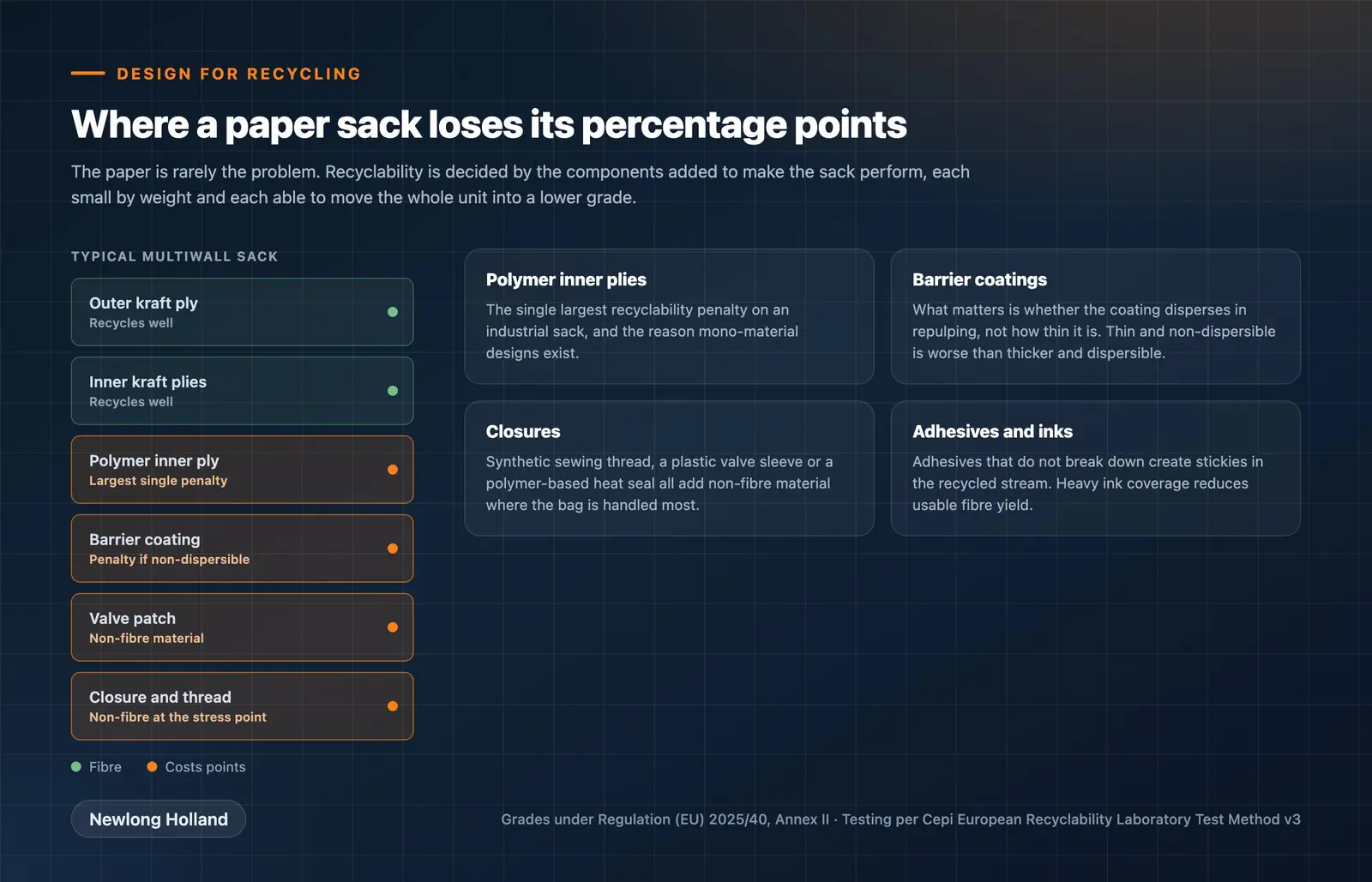
The short answer: the paper is rarely the problem. Percentage points are lost at the liner, the coating, the closure and the adhesive, which together are a small share of the weight but can put the whole unit into a lower grade.
A multiwall paper sack is mostly kraft paper, and kraft paper recycles well. What pulls a unit down is everything added to make it perform: a polyethylene inner ply for moisture barrier, a coating for grease or oxygen resistance, a plastic valve patch, a sewn closure with polypropylene thread, a hot-melt adhesive that will not disperse. Each is small in weight. Each can be the reason a repulper rejects the unit or a sorting line sends it to the reject stream.
- Polymer inner plies. The single largest recyclability penalty on an industrial sack, and the one that mono-material designs exist to remove.
- Barrier coatings. Whether a coating is a problem depends on whether it disperses in repulping, not on how thin it is. A thin non-dispersible coating can be worse than a thicker dispersible one.
- Closures. A sewn closure with synthetic thread, a plastic valve sleeve, or a heat seal that relies on a polymer layer each add non-fibre material at the exact point where the bag is handled most.
- Adhesives and inks. Adhesives that do not break down produce stickies in the recycled stream. Heavy ink coverage affects the yield of usable fibre.
The practical consequence is that recyclability is decided by the specification of the whole unit, not by the paper you buy. Two sacks made from identical kraft can land in different grades because of a valve patch.
Mono-material in practice: what replaces the plastic
The short answer: mono-material means the barrier and the closure are delivered in fibre or in a dispersible coating instead of a separate polymer layer. It changes what the line has to handle, because paper with a functional coating does not run like plain kraft.
The substitution is well understood in principle. Moisture and grease resistance move from a polyethylene ply to a dispersion coating applied to the paper itself. Sealability moves from a polymer film to a heat-sealable coating. The valve sleeve moves from plastic to paper. What is less well understood is what each substitution does to a production line.
Coated papers behave differently under tension, and the coating changes how the web responds to heat and glue. Heat-sealable coatings need a tighter temperature window than a polymer film, because the same heat that forms the seal can damage the coating outside it. Dispersion-coated stock is often stiffer, which affects forming and folding. None of this is prohibitive, but it does mean a line configured years ago for uncoated kraft and a polyethylene liner is not automatically ready to run a mono-material equivalent at the same speed and scrap rate. This is the same paper-behaviour question we covered for bag making lines generally: the machine has to be set up around the grade you actually run.
Closing methods and where they sit on recyclability
The short answer: the closure is a small part of the weight and a large part of the risk. It is the component most likely to be the reason a unit drops a grade, and it is also the easiest to change without rebuilding the whole line.
Three closing families dominate industrial paper bags, and they do not behave the same way in a recycling stream. Sewn closures are mechanically excellent and completely reversible, but the thread matters: synthetic thread is non-fibre material that has to be separated. Heat-sealed closures produce a clean, dust-tight seal but historically relied on a polymer layer, which is precisely what a mono-material design is trying to remove, so the question becomes whether the seal can be achieved on a dispersible heat-sealable coating instead. Water-tape or glued closures use a paper tape and a water-based adhesive and sit naturally closest to a fibre-only construction, provided the adhesive disperses.
| Closing method | Non-fibre material introduced | Fits a mono-material design? | Typical use |
|---|---|---|---|
| Sewn, synthetic thread | Polypropylene or polyester thread | Only if the thread is separated or substituted | Cement, aggregates, animal feed |
| Sewn with paper tape over | Thread plus paper tape | Partially; depends on thread and adhesive | Dust-sensitive bulk products |
| Heat sealed on polymer layer | Polyethylene sealing layer | No | Moisture-sensitive powders |
| Heat sealed on dispersible coating | None, if the coating disperses | Yes | Food-grade powders, milk powder |
| Water-tape or glued | Water-based adhesive only | Yes, if the adhesive disperses | Valve bags, retail formats |
Which one is right depends on the product, not on recyclability alone. A 25 kg sack of cement, a food-grade sack of milk powder and a valve bag of granulate impose different demands on dust-tightness, speed and handling. Our bag sewing and bag engineering ranges cover sewn, heat-sealed and taped closures precisely because the right answer changes per application. What the regulation adds is a new question to ask alongside the old ones: does this closure keep the finished unit inside a single recycling stream.
How recyclability is actually tested
The short answer: there is an established European laboratory method, and it is not the same thing as a supplier claim. If a material supplier tells you a paper is recyclable, ask which method was used and what the result was.
The reference method is the Cepi European Recyclability Laboratory Test Method. Version 3 was published on 28 February 2025, replacing a method first issued in 2021, and the update was written specifically to harmonise testing so that a much larger number of European laboratories can assess fibre-based packaging consistently. Alongside it, the 4evergreen alliance, which brings together more than 380 experts from across the value chain, has issued a recyclability evaluation protocol that tells developers how to interpret the test results.
Together those two documents are how a claim becomes evidence. The test method produces numbers. The evaluation protocol says what those numbers mean. For a converter this matters commercially as well as technically, because when a brand owner asks for proof of recyclability in 2029, a test result against a named method is an answer and a supplier assurance is not.
For context on how much room is left: paper packaging in Europe already recycles at 83.2% according to Eurostat figures cited by Cepi, against an industry target of 90% by 2030. Paper starts from a strong position. The regulation is not asking the sector to solve an unsolved problem, it is asking individual packs to stop being the exceptions.
What to put in a machine specification now
The short answer: specify the paper range and the closure options the line must support, not a compliance promise. Regulations change; the physical capability of a machine to run a coated mono-material web and produce a fibre-only closure is what carries you through.
- The paper range, stated as grades and grammages. Include the dispersion-coated and heat-sealable coated stocks you expect to run by 2030, not only what you run today. Tension control and glue application are configured around this.
- The closure options the line must support. If you may need to move from a sewn closure with synthetic thread to a taped or coated heat-sealed closure, that has to be a designed-in option rather than a later rebuild.
- The temperature window for sealing. Heat-sealable coatings are less forgiving than polymer films. Ask for the control tolerance, not just the maximum temperature.
- Scrap rate on coated stock specifically. A scrap figure measured on plain kraft tells you little about how the line will behave on a stiffer coated web.
- Changeover time between constructions. If half your customers reformulate to reach Grade B and half do not, you will be running both for years.
None of this requires you to guess at the detail of future delegated acts. The Commission will set the design-for-recycling criteria and the assessment methodology through further acts, and the specifics will move. What will not move is that a line has to physically handle mono-material paper and produce a closure that stays in one recycling stream. Specify the capability, not the paperwork.
Frequently asked questions
What are the PPWR recyclability grades A, B and C?
They are performance grades based on the share of a packaging unit, by weight, that can be recycled. Grade A is 95% or higher, Grade B is 80% or higher and Grade C is 70% or higher. Packaging below Grade C cannot be placed on the EU market. The thresholds are set out in Annex II of Regulation (EU) 2025/40.
When does each recyclability grade become mandatory?
From 1 January 2030 packaging must reach at least Grade C to be placed on the EU market. From 1 January 2038 the minimum rises to Grade B. In between, from 1 January 2035, grades are assessed on both design-for-recycling and recycled-at-scale criteria rather than design-for-recycling alone.
Why should I design for Grade B instead of Grade C?
Because Grade C stops being sufficient on 1 January 2038, and a bag making line bought in 2027 will still be in service then. Designing to the 70% threshold satisfies the first deadline and fails the second, which turns a compliance question into an asset life question.
What does mono-material mean for a paper sack?
It means the barrier and closure functions are delivered in fibre or in a dispersible coating rather than by a separate polymer layer. In practice that usually means removing the polyethylene inner ply, replacing it with a dispersion coating on the paper, and using a closure that does not introduce non-fibre material.
What usually causes a paper bag to lose recyclability points?
Rarely the paper itself. The usual causes are a polymer inner ply, a non-dispersible barrier coating, a plastic valve patch, synthetic sewing thread and adhesives that do not break down in repulping. Each is small by weight but can be enough to move the whole unit into a lower grade.
Does a thinner coating always help recyclability?
No. What matters is whether the coating disperses during repulping, not how thin it is. A thin coating that does not disperse can cause more trouble in the recycling stream than a thicker coating that does.
Which closing method is best for recyclability?
Taped or glued closures using paper tape and a water-based dispersible adhesive sit closest to a fibre-only construction. Sewn closures are excellent mechanically but the thread has to be considered. Heat sealing can work within a mono-material design if the seal is achieved on a dispersible heat-sealable coating rather than a polymer layer. The right choice still depends on the product and the filling speed.
How is paper packaging recyclability tested in Europe?
Through the Cepi European Recyclability Laboratory Test Method, whose version 3 was published on 28 February 2025 and replaced a method first issued in 2021. The 4evergreen alliance publishes a companion recyclability evaluation protocol that sets out how to interpret the results. A recyclability claim without a named test method behind it is not evidence.
Do I need to replace my bag making line to comply?
Not necessarily. Many lines can run coated mono-material stock with reconfiguration of tension control, glue application and sealing parameters. The question is whether that reconfiguration is possible on your machine and what it does to speed and scrap rate. That is worth establishing before 2029, not after.
Does coated paper run at the same speed as plain kraft?
Usually not without adjustment. Dispersion-coated stock tends to be stiffer, which affects forming and folding, and heat-sealable coatings need a tighter temperature window than a polymer film. Ask any supplier for the scrap rate measured on coated stock specifically rather than on plain kraft.
What is the current recycling rate for paper packaging in Europe?
83.2%, according to Eurostat figures cited by Cepi, against an industry target of 90% by 2030. Paper packaging therefore starts from a strong position relative to other materials, and the regulation is largely about bringing individual pack designs into line rather than building a recycling system from scratch.
What does recycled-at-scale mean and when does it apply?
It means the packaging is not only designed to be recyclable but is actually collected, sorted and recycled in volume in practice. From 1 January 2035, recyclability grades are assessed on both design-for-recycling and recycled-at-scale criteria, where until then design-for-recycling alone determines the grade.
Specifying for 2038, not 2030
The regulation gives converters two deadlines and most planning only registers the first. Grade C in 2030 is the easy one. Grade B in 2038 is the one that decides whether a machine bought next year is still earning at the end of its life. We covered the wider compliance picture in our guide to EU packaging regulations for paper bag manufacturers.
If you are specifying a line and want to know whether it will still be compliant in its second decade, our engineering team will go through your paper range, closure requirements and product mix and tell you what needs to be designed in now rather than retrofitted later. Get in touch and we will start from what you actually run.