



Paper Bag Machine Buyer’s Checklist: 15 Questions to Ask Every Vendor
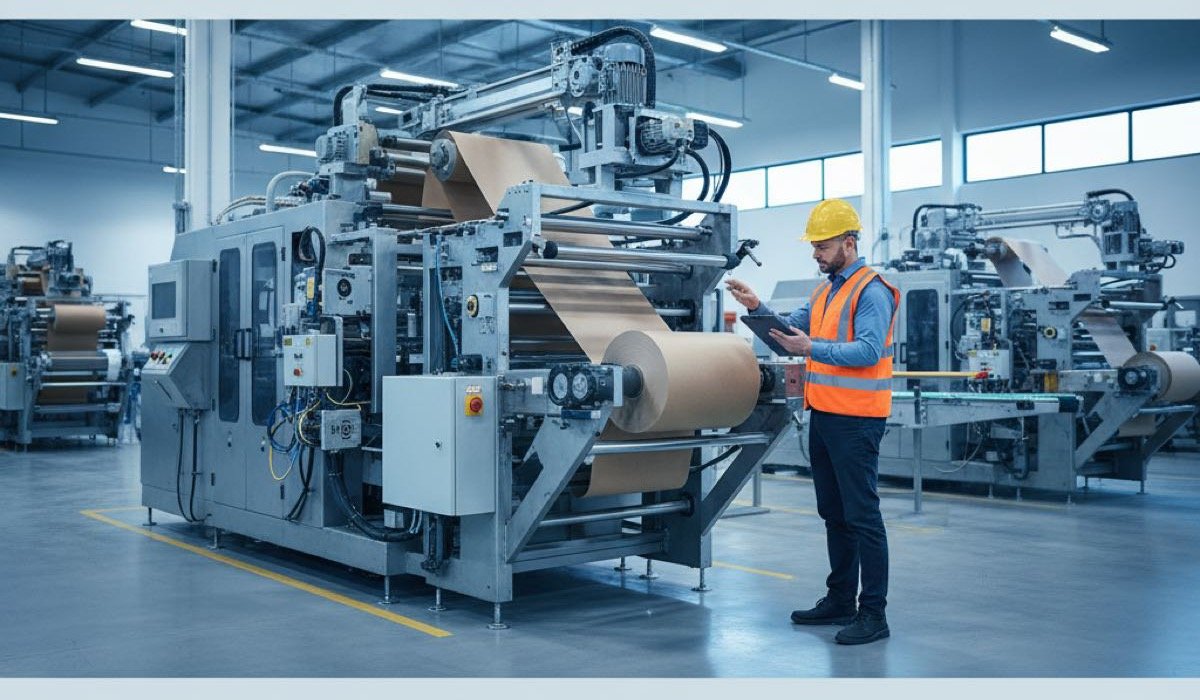
Buying a paper bag machine is a major capital decision you will live with for 10 to 20 years. The paper bag machine you choose will shape your production capacity, your operating costs, your maintenance burden, and your ability to respond to changing market demands. Get it right, and you have a reliable production asset for decades. Get it wrong, and you are locked into a machine that underperforms, breaks down, and costs more to operate than it should.
The challenge is that every vendor will tell you their machine is the best. Brochures look similar. Specifications appear comparable. The real differences only emerge when you ask the right questions — and know what the answers should be.
This paper bag machine buyer’s checklist gives you 15 specific questions to ask every paper bag machine vendor, organised by category. Whether you are investing in your first paper bag machine or upgrading existing packaging equipment, each question includes context on why it matters and guidance on what a strong answer looks like. Use it as a structured paper bag machine evaluation framework, whether you are buying your first machine or replacing existing equipment.
Technical Capability: Paper Bag Machine Specifications
1. What is the proven production speed under real operating conditions — not theoretical maximum?
Why it matters: Every machine has a rated maximum speed. Very few operate at that speed in actual production. The gap between theoretical maximum and sustainable operating speed can be 20 to 40 percent, depending on the product being bagged, the bag material, and environmental conditions.
What to look for: A vendor who provides realistic throughput figures for your specific product and bag type, backed by reference installations. Ask for the sustained speed — the rate the machine can maintain over an eight-hour shift without quality degradation or excessive wear. If a vendor only quotes the peak speed, press for clarification.
2. What range of bag sizes, materials, and formats can this machine handle?
Why it matters: Your product range may change. Your customers may request different bag sizes. Packaging regulations may require different materials. A paper bag machine that handles only one bag format is a risk if your requirements evolve.
What to look for: Machines designed for versatility across multiple bag formats — multi-wall paper, single-wall, valve bags, open-mouth bags, SOS bags — without requiring extensive mechanical modification. Newlong’s bag making machines are engineered to handle a range of paper, plastic, and woven materials, reflecting the reality that most operations need flexibility.
3. What is the demonstrated fill weight accuracy, and what weighing technology is used?
Why it matters: Fill weight accuracy directly affects product giveaway costs and regulatory compliance. A machine that consistently overfills by even 0.5 percent costs you significant raw material over a year of production. Under-filling creates compliance risks and customer complaints.
What to look for: Gross-weight or net-weight systems with documented accuracy tolerances under production conditions. The OIML R61 recommendation provides the international framework for automatic gravimetric filling instrument accuracy classes — understanding which class applies to your application helps set realistic expectations. Multi-head weighers and loss-in-weight systems generally deliver tighter tolerances than volumetric filling. Ask for accuracy data from installed machines running comparable products, not laboratory test results.
4. What closure methods are available, and can you switch between them?
Why it matters: Different products, markets, and end-use requirements call for different bag closures — sewn, heat-sealed, glued, or folded. Having the flexibility to offer multiple closure types from a single line gives you a competitive advantage.
What to look for: Machines that can accommodate bag sewing and heat sealing with minimal changeover effort. Some systems allow switching between closure methods within the same line — a significant operational advantage.
Production Flexibility
5. How long does a product changeover actually take, and what does it involve?
Why it matters: Changeover time is dead time. If your operation runs multiple products or bag sizes, changeover frequency directly impacts your effective production capacity. A machine that takes 90 minutes to change over versus one that takes 20 minutes can mean the difference between three product runs per shift and five.
What to look for: Tool-less changeover mechanisms, stored recipe management in the HMI, and clear documentation of changeover procedures with realistic time estimates. Ask the vendor to demonstrate a changeover — or, better yet, ask for a reference site where you can observe one during a visit.
6. Can the machine handle your full range of products — including the difficult ones?
Why it matters: Free-flowing granules are easy. Fine powders, hygroscopic materials, products with high fat content, or abrasive compounds are not. The machine must handle your most challenging product reliably, not just your easiest one.
What to look for: Experience with your specific product type, evidenced by reference installations. Newlong’s bag engineering division conducts fundamental material studies for each application — testing how materials behave during filling, weighing, and transport — before recommending a system configuration. This level of product-specific engineering is the difference between a machine that works in theory and one that works in production.
7. What is the minimum economical run length?
Why it matters: If your business includes short runs — small batch orders, custom products, or seasonal items — you need a machine that reaches steady-state operation quickly and does not waste excessive material during startup and shutdown.
What to look for: Low startup waste, fast stabilisation of fill weights and sealing parameters, and efficient changeover procedures that make short runs economically viable.

Integration and Automation
8. What communication protocols does the machine support for ERP, MES, and SCADA integration?
Why it matters: Your packaging equipment needs to communicate with your broader production and business systems. Machines that cannot integrate with ERP, MES, or SCADA create data islands and manual data entry bottlenecks.
What to look for: Support for OPC-UA as a minimum, with options for MQTT, PROFINET, EtherNet/IP, or Modbus TCP depending on your existing infrastructure. Open communication architectures — not proprietary protocols that lock you into vendor-specific solutions. Newlong’s automatic bagging systems are built on open architectures that integrate with standard industrial control and enterprise systems.
9. How does the machine integrate with upstream and downstream equipment?
Why it matters: A bagging machine does not operate in isolation. It receives product from upstream processing (silos, mixers, conveyors) and delivers filled bags to downstream handling (check-weighers, metal detectors, palletisers, stretch wrappers). The interfaces between these systems determine overall line efficiency.
What to look for: Standardised mechanical and electrical interfaces, documented integration points, and experience integrating with common upstream and downstream equipment. Ask whether the vendor provides complete line engineering or only the bagging machine itself.
10. What level of automation is included, and what is available as an upgrade?
Why it matters: Your automation needs may evolve. A machine that offers a clear upgrade path — from semi-automatic to fully automatic operation, from manual bag placement to automatic bag application — protects your investment as your production requirements change.
What to look for: Modular automation architecture where capabilities can be added without replacing the core machine. Newlong’s automatic bagging machines are designed with this modularity in mind, allowing incremental automation that aligns with your operational growth.

Support and Service
11. Where are spare parts held, and what are typical delivery times?
Why it matters: This is one of the most important questions on this list, and one that many buyers neglect. A paper bag machine waiting for a spare part is a machine not producing. If critical components ship from the other side of the world with 8 to 12 week lead times, your downtime costs will dwarf any savings on the purchase price.
What to look for: Local or regional spare parts inventory with documented delivery times for critical components. Newlong Holland maintains spare parts stock in the Netherlands for European customers, with additional supply from the factory in Japan — providing both rapid response and comprehensive availability.
12. What does the warranty cover, and what does it exclude?
Why it matters: Warranties vary enormously between manufacturers. Some cover everything including wear parts for two years. Others cover only the main structure and exclude the components most likely to fail. The warranty terms reveal a lot about a manufacturer’s confidence in their own equipment.
What to look for: Clear, written warranty terms that specify coverage duration, included components, exclusions, and the process for making a claim. Ask specifically about wear parts, electrical components, and labour costs for warranty repairs.
13. What technical support is available, and in what time zone?
Why it matters: When your machine has a problem at 06:00 on a Monday morning, you need to reach someone who can help — not leave a voicemail for a support team that operates in a different time zone and will get back to you in 24 to 48 hours.
What to look for: Local technical support with direct phone access during your operating hours. Remote diagnostic capabilities that allow the vendor’s engineers to assess machine issues without being physically present. Documented escalation procedures for critical breakdowns. As part of a global organisation with European operations, Newlong provides accessible support across European time zones.
Financial Considerations: Paper Bag Machine Investment
14. Can you provide a total cost of ownership estimate — not just the purchase price?
Why it matters: The paper bag machine purchase price is typically only 25 to 35 percent of the total cost over a machine’s lifecycle. Maintenance, energy, spare parts, downtime, and training costs make up the balance. A vendor who can provide a realistic TCO estimate demonstrates both transparency and confidence in their equipment’s long-term performance.
What to look for: A vendor willing to provide estimated maintenance schedules and costs, expected spare parts consumption, energy consumption figures under realistic operating conditions, and expected machine lifespan. Be cautious of vendors who only want to discuss the purchase price — they may have something to hide in the downstream costs.
According to PMMI (The Association for Packaging and Processing Technologies), leading equipment manufacturers increasingly provide lifecycle cost analysis as a standard part of their sales process. This transparency benefits both buyer and seller.
15. What is the expected machine lifespan, and what references can demonstrate long-term reliability?
Why it matters: A paper bag machine’s lifespan directly affects the cost per bag produced over its lifetime. A machine that lasts 20 years amortises its acquisition cost over twice as many production hours as one that lasts 10 years.
What to look for: Documented reference installations where machines have been operating reliably for 10 or more years. Newlong has been manufacturing packaging machinery since 1941, and there are Newlong machines in operation around the world that have been running productively for decades. This long-term durability is not an accident — it is the result of engineering choices made at the design stage: material selection, bearing specification, component quality, and build precision.
Using This Checklist
Print this paper bag machine buyer’s checklist. Bring it to every vendor meeting. Send it as part of your RFQ (Request for Quotation). The paper bag machine vendors who welcome these questions are typically the ones who have the best answers.
Pay particular attention to how vendors respond to the questions they cannot answer fully. A good supplier will acknowledge limitations honestly and explain how they mitigate them. A poor one will deflect, change the subject, or make promises without substantiation.
Also, weigh the answers collectively. No machine will score perfectly on every criterion. The goal is to identify the equipment that best fits your specific production requirements, integration environment, and long-term operational strategy — not to chase perfection on individual specifications.
The Right Partner for the Long Term
A paper bag machine is a long-term production asset, and the paper bag machine vendor relationship extends well beyond the initial sale. Spare parts supply, technical support, maintenance expertise, and engineering upgrades are all part of a multi-decade partnership.
Newlong has been building that kind of partnership with packaging operations worldwide since 1941. If you are evaluating paper bag equipment and want to see how your requirements align with our capabilities, contact our team for a detailed discussion. We welcome every question on this checklist — and any others you might have.