



EU Packaging Regulations for Paper Bags: A 2026 to 2030 Compliance Guide
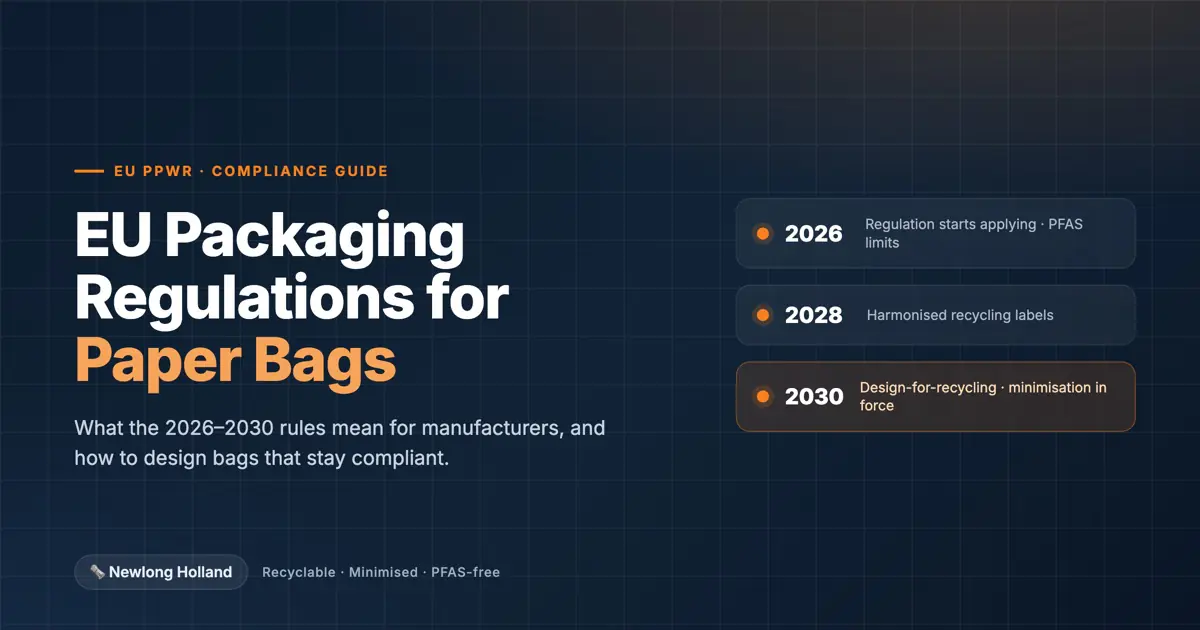
If you make, fill, or buy paper bags for the European market, the rules you design around are changing. The EU packaging regulations for paper bags now fall under the Packaging and Packaging Waste Regulation (PPWR), which entered into force in early 2025 and starts applying in August 2026, with tighter requirements phasing in through 2030 and beyond. Unlike the old directive it replaces, the PPWR is a regulation, which means it applies directly and identically in every member state. There is no national transposition to wait for and no local variation to hide behind.
The good news for fibre-based packaging is real: paper starts from a strong position. It is widely collected, widely recycled, and made from a renewable feedstock. But “made of paper” is not the same as “compliant”. The details that decide compliance, closures, coatings, adhesives, printing, and how easily the whole bag separates back into a single recyclable stream, are exactly the details that machinery and converting choices control. This guide walks a paper bag manufacturer through what the PPWR actually requires, when each milestone lands, and where the practical risks and opportunities sit.
What the PPWR is, and why it replaced the old directive
For decades, packaging rules in Europe were set by the Packaging and Packaging Waste Directive (94/62/EC). A directive sets goals and leaves each country to write its own law. The result was 27 slightly different rulebooks, which made compliance expensive and enforcement uneven. The PPWR changes the instrument itself. As a regulation it is a single, directly applicable text across the entire EU internal market.
Its core ambition is simple to state and demanding to meet: all packaging placed on the EU market must be recyclable, packaging waste must fall in absolute terms, and the amount of material used per unit must come down. For paper bag producers the message is that the market will increasingly reward genuinely recyclable, right-sized, mono-material designs, and increasingly penalise anything that contaminates the paper recycling stream or uses more material than the product needs.
The compliance timeline: 2025 to 2030 and beyond
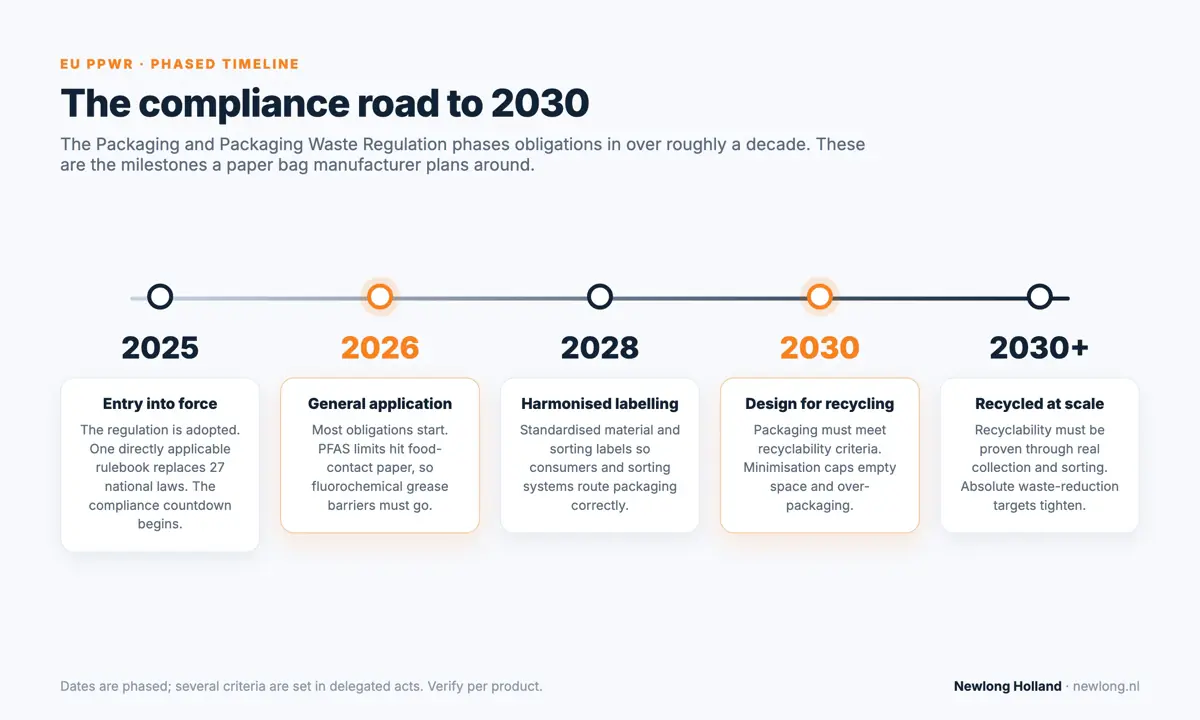
The PPWR does not switch on all at once. It phases obligations in over roughly a decade. These are the milestones that matter most to a paper bag manufacturer or buyer. Confirm the precise dates and delegated acts for your specific product with your compliance advisor, because several criteria are still being detailed in secondary legislation.
- Early 2025, entry into force. The regulation is on the books. The countdown to the first binding obligations begins.
- August 2026, general application. The bulk of the regulation starts to apply. This includes the first restrictions on substances of concern, notably PFAS limits in food-contact packaging, which matters for grease-resistant paper.
- 2028, harmonised labelling. Packaging is expected to carry standardised material-composition and sorting labels so consumers and sorting systems can identify the stream correctly.
- 2030, design for recycling. Packaging placed on the market must meet design-for-recycling criteria. Minimisation rules limit empty space and over-packaging, and certain unnecessary single-use plastic formats are restricted.
- 2030 onwards, recyclability at scale and waste reduction. Recyclability must be demonstrable not just in theory but through actual collection and sorting infrastructure, and absolute packaging-waste reduction targets tighten against a 2018 baseline.
The practical takeaway: any bag design or line configuration you commission today will still be in service when the 2030 rules bite. Designing for those rules now is cheaper than retrofitting later.
What “recyclable” now means for a paper bag
Under the PPWR, recyclability is not a claim you make, it is a performance grade you have to meet. Packaging is assessed on design-for-recycling criteria and, later, on whether it is actually recycled at scale. Grades run from high performance down to a threshold below which packaging can no longer be placed on the market. For paper, this reframes several everyday design choices:
Mono-material beats composite
A bag that is paper through and through, body, seams, and closure, drops cleanly into the paper recycling stream. Add a plastic film liner, a non-paper valve, a plastic carry handle, or a laminated barrier layer, and you create a composite that sorting facilities may reject or downgrade. Every non-fibre component is a compliance risk and a recyclability penalty. The design instinct the PPWR rewards is: keep it fibre, and if you cannot, make the non-fibre part easily separable.
Closures are a compliance decision, not an afterthought
How a bag is closed is one of the most overlooked recyclability factors. A paper bag sewn shut with a cotton or paper tape, or closed with a water-activated paper tape, stays mono-material. A bag closed with a plastic clip, a heat-sealed hot-melt strip, or a laminated fold introduces plastic into an otherwise fibre bag and can compromise the whole unit. This is precisely where converting technology decides the compliance outcome. Standard heat-sealing still relies on plastic or hot-melt to form the seal, so where full mono-material recyclability is the goal, a paper-only closing method, such as the water-tape approach behind our Watts bag-closing solution, lets producers hit recyclability targets without redesigning the bag body.
Coatings, inks, and adhesives count
Barrier coatings that resist grease or moisture are useful, but heavy plastic or wax coatings reduce fibre recovery. Water-based inks and repulpable adhesives keep a bag in the recyclable grade; solvent-heavy inks and permanent laminating adhesives push it down. As PFAS restrictions take effect from 2026 in food-contact applications, the traditional fluorochemical grease barriers are on the way out, replaced by fibre-based or dispersion coatings that are both compliant and recyclable.
Minimisation: using less material by design
Alongside recyclability, the PPWR attacks over-packaging directly. Packaging must be minimised in weight and volume to what is necessary for function and safety, and empty space in grouped, transport, and e-commerce packaging is capped. For a paper bag manufacturer this is an opportunity as much as a constraint. Right-sizing a bag to its contents cuts material cost per unit, cuts freight, and improves the sustainability story all at once. The converters who win here are the ones whose lines can produce a tuned range of sizes efficiently, rather than forcing every product into a handful of oversized formats.
Why paper is well-positioned, and where the traps are
Paper enters the PPWR era with structural advantages. Fibre packaging already has high, established collection and recycling rates across Europe, so it clears the “recycled at scale” hurdle more easily than many alternatives. It is renewable, and it substitutes directly for single-use plastic formats that the regulation is actively restricting. For brands under pressure to decarbonise packaging, a well-designed paper bag is one of the cleanest moves available.
The traps are all in the details. A paper bag with a plastic window, a laminated foil barrier, a PE-lined interior, or a plastic closure is not a paper recyclability story, it is a composite one. Grease-barrier papers that still rely on PFAS will fall foul of the substance restrictions. And a bag that is technically recyclable but carries the wrong label, or no label, still fails the labelling obligation. Compliance is holistic: the body, the barrier, the closure, the print, and the label all have to line up.
A practical PPWR compliance checklist for paper bag producers
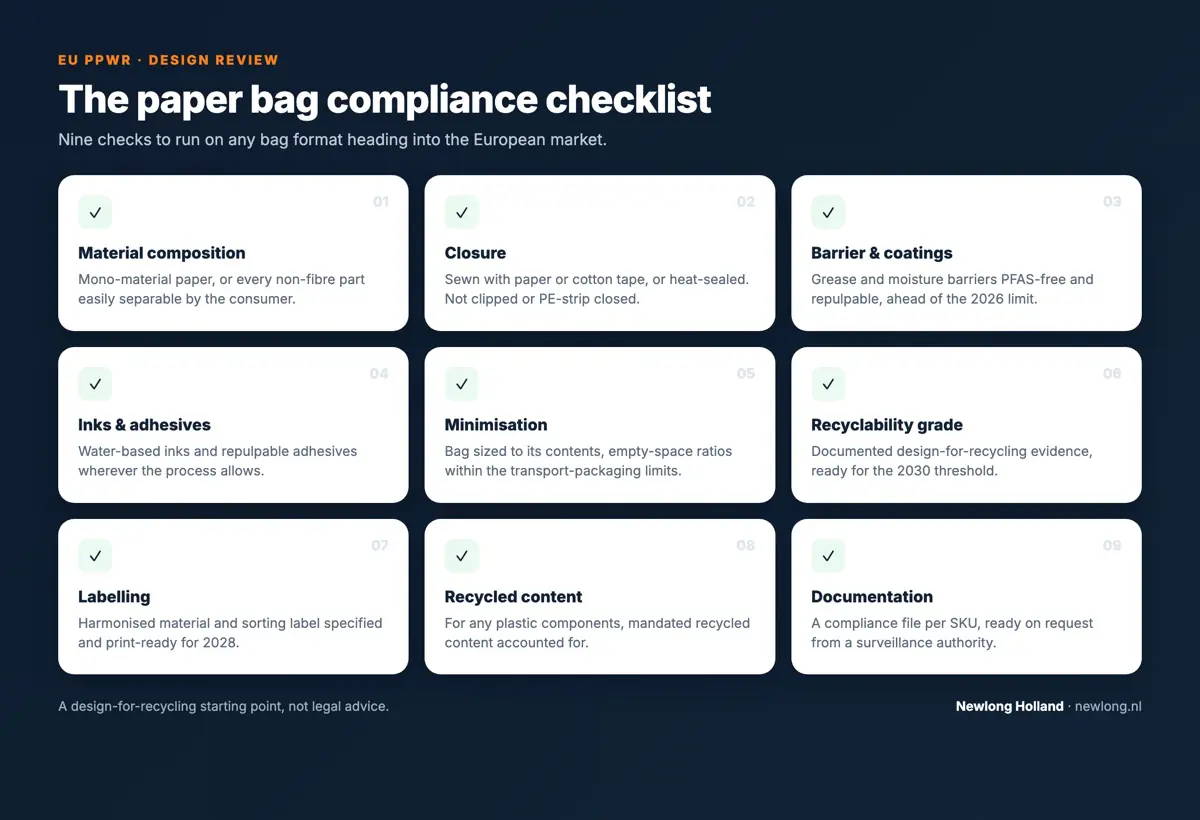
Use this as a design-review checklist for any new or existing paper bag format heading into the European market.
- Material composition. Is the bag mono-material paper? If not, is every non-fibre component either removed or easily separable by the consumer?
- Closure. Is the bag closed in a way that keeps it recyclable, sewn with paper or cotton tape, or heat-sealed, rather than clipped or PE-strip closed?
- Barrier and coatings. Are grease and moisture barriers PFAS-free and repulpable? Have you replaced fluorochemical coatings ahead of the 2026 restriction?
- Inks and adhesives. Water-based inks and repulpable adhesives wherever possible.
- Minimisation. Is the bag sized to its contents, with empty-space ratios within the limits for grouped and transport packaging?
- Recyclability grade. Do you have documented evidence of the design-for-recycling grade, ready for the 2030 threshold?
- Labelling. Is the harmonised material and sorting label specified and print-ready for the 2028 obligation?
- Recycled content, where relevant. For any plastic components, is mandated recycled content accounted for?
- Documentation. Can you produce a compliance file per SKU on request from a market surveillance authority?
How Newlong helps manufacturers stay ahead of the regulation
Compliance is designed into the bag on the production line, not bolted on afterwards. That is where the right machinery matters. Newlong builds and supplies the paper bag making and closing equipment that lets converters produce fully recyclable, right-sized, mono-material bags at industrial speed. Our standard heat-sealing and sewing systems close bags reliably at speed, using plastic or hot-melt in the seal itself, so those components still need to be accounted for in a recyclability assessment. Where a fully mono-material, paper-only closure is the goal, our Watts system closes the bag with a water-activated paper tape and no plastic at all, keeping the finished unit in the highest recyclability grade. Our lines are built for efficient size changeovers, which is exactly what the minimisation rules demand.
Just as important, we help customers think about compliance and operation together. A recyclable bag is only worth producing if you can run the line reliably, which is why we pair equipment with commissioning, operator training, and maintenance support, the same discipline we set out in our operator training guide. If you are reviewing your paper bag range against the PPWR, we can advise on the closing and converting choices that keep you compliant without a full redesign.
Frequently asked questions
1. When does the EU PPWR start applying to paper bags?
The regulation entered into force in early 2025 and the bulk of its obligations start applying in August 2026. Key requirements such as design-for-recycling criteria and packaging minimisation tighten from 2030, with harmonised labelling expected around 2028. Because dates are phased and some criteria are set in secondary legislation, verify the exact timeline for your product category.
2. Are paper bags automatically compliant because they are recyclable?
No. Being made of paper is a strong start, but compliance depends on the whole unit. Plastic liners, hot melt, windows, non-paper closures, PFAS grease barriers, or missing sorting labels can each put an otherwise paper bag out of compliance. Recyclability is assessed on the finished product, not the base material.
3. What is the difference between the PPWR and the old packaging directive?
The old rules were a directive (94/62/EC), which each member state turned into its own national law, creating variation across the EU. The PPWR is a regulation, so it applies directly and identically in all member states. That means one rulebook, uniform enforcement, and no waiting for national transposition.
4. Does the PPWR require recycled content in paper bags?
The mandatory recycled-content targets in the PPWR are aimed primarily at plastic packaging. Paper is governed mainly through recyclability, minimisation, and substance restrictions rather than a recycled-content mandate. If your paper bag includes plastic components, those components may fall under the recycled-content rules.
5. How does bag closure affect compliance?
Closure is one of the biggest hidden factors. A plastic clip, a heat-sealed hot-melt strip, or a laminated closure can turn a mono-material paper bag into a composite that sorting facilities downgrade. Sewing with paper or cotton tape, or a paper-only water-tape closure, preserves the top recyclability grade without introducing plastic.
6. What happens to PFAS grease-resistant paper?
PFAS restrictions in food-contact packaging take effect from 2026, so fluorochemical grease barriers are being phased out. Producers are moving to PFAS-free, repulpable barrier solutions such as dispersion coatings, which are both compliant and compatible with paper recycling.
7. What are the packaging minimisation rules?
The PPWR requires packaging to be reduced to the minimum weight and volume needed for function and safety, and caps empty space in grouped, transport, and e-commerce packaging. In practice this means right-sizing bags to their contents and avoiding oversized formats, which also lowers material and freight cost.
8. Do we need a new label on our paper bags?
Harmonised labelling is expected around 2028, requiring standardised material-composition and sorting information so consumers and sorting systems can route the packaging correctly. Plan your artwork and print process now so the label can be added without disrupting production later.
9. Who is responsible for compliance, the bag maker or the brand?
Responsibility sits across the chain. The economic operator placing the packaging on the market carries the legal obligation, but converters and machinery choices determine whether the bag can meet the criteria at all. In practice, bag makers who can demonstrate recyclable, minimised, PFAS-free designs become the easier supplier for brands to work with.
10. What is the risk of waiting until 2030 to act?
Equipment and bag designs commissioned today will still be running when the 2030 rules apply. Retrofitting closures, coatings, or line configurations later is more expensive and disruptive than designing for compliance now. Early movers also gain a commercial edge with sustainability-focused customers.
11. Where can I read the official regulation?
The consolidated text and guidance are published by the European Commission on its packaging waste pages, and industry bodies such as FEFCO track the implications for fibre-based packaging. Always cross-check the current official text, since delegated acts continue to detail specific criteria.
Turn the regulation into an advantage
The PPWR is often framed as a burden, but for paper it is closer to a tailwind. The regulation pushes the market exactly where fibre-based packaging is strongest: recyclable, renewable, minimised, and free of problematic plastics. The manufacturers who move first, redesigning closures, dropping PFAS barriers, and right-sizing their range, will be the easy, low-risk choice for brands scrambling to comply. Whether you are commissioning a new paper bag line or future-proofing an existing one, talk to our team about the converting and closing choices that keep you ahead of the 2030 deadline.